Everyone is analysing Guzman y Gomez’s US exit through strategy, competition, food, or finance. But the deeper pattern — the one that explains the outcome — sits in behaviour.
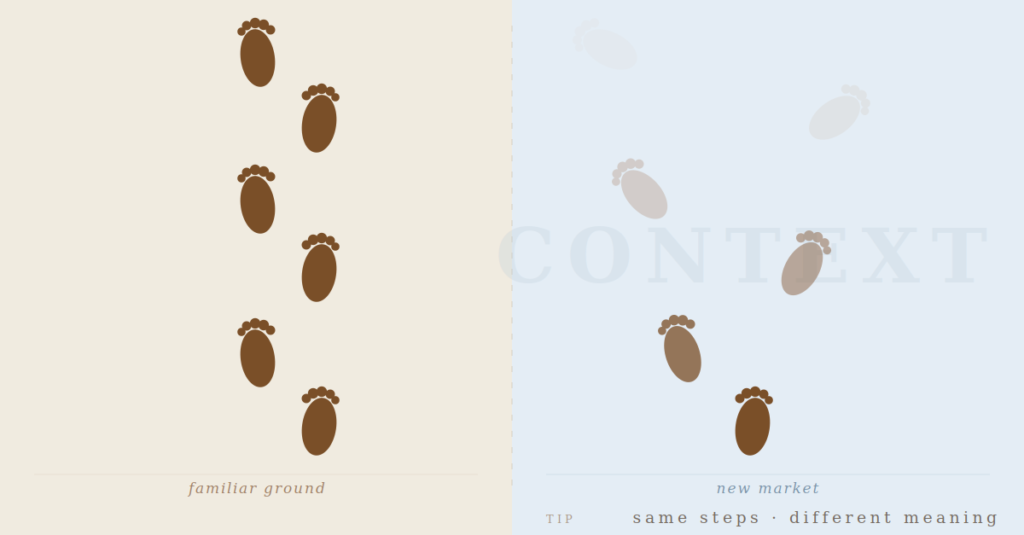
A product that works in one market doesn’t automatically work in another. Not because the product is weak. Not because the team is wrong. But because behaviour is shaped by context — culture, memory, expectation, rhythm.
In hospitality, I’ve seen this for two decades:
- A dish that becomes a ritual in one city barely moves in another.
- A service style that feels warm in one culture feels intrusive in another.
- A brand that feels “fresh” at home feels “familiar” somewhere else.
The behaviour is the same. The meaning is not.
Context Changes Everything
The same truth applies online. A website, a campaign, a digital journey — none of it travels cleanly unless the behaviour underneath is understood.
When behaviour and context misalign, even good products struggle. When they align, even simple products rise.
Most brands don’t struggle because of strategy. They struggle because the behaviour they’re built on doesn’t match the behaviour of the market they enter.
That mismatch is subtle, but it’s the one that breaks momentum long before performance metrics show it — including indicators like Expansion Velocity, which often reveal the behavioural gap only after it has already taken root.
We’ve Seen This Pattern Before
Taco Bell couldn’t crack Mexico — not because of product, but because local taste memory and cultural expectations created an instant behavioural mismatch.
And in the US, the behavioural template for “Mexican fast‑casual” is already owned by Chipotle. Not because Chipotle is better, but because it has shaped the local mental shortcuts for what this category should feel like — pace, portion, flavour memory, ordering rhythm. When a market already has a dominant behavioural reference point, any new brand enters a pre‑set context. If its signals don’t match that context, friction appears immediately.
GYG even tried adjusting its product to match local expectations — offering larger burritos in the US than in Australia. That wasn’t a pricing play; it was an attempt to align with the American value‑perception shortcut: “bigger portion = better deal.” But when the underlying behavioural template is already owned by another brand, even well‑intentioned adaptations struggle to shift the default choice.
Even Daniel Kahneman’s work points to something useful: people often think in two modes — a fast, automatic, context‑driven mode and a slower, deliberate, analytical one. They’re not literal “systems,” but they’re a helpful way to understand why behaviour shifts across environments.
People rarely analyse; they react. They don’t compare; they recognise. They don’t evaluate; they decide — quickly, instinctively, and often without knowing why.
When a brand enters a new market, it enters a new fast‑thinking environment. If the local mental shortcuts don’t match the brand’s signals, friction appears long before strategy does.
GYG’s Moment Isn’t About Failure
It’s a reminder of something most businesses overlook:
Behaviour is local. Brands are global. And the gap between the two decides what works and what doesn’t.
That’s the gap most brands never see — and the gap TIP was created to make visible.
A quiet system built at the intersection of behavioural patterns and digital systems, where context quietly decides whether a brand feels natural or out of place.
Because when behaviour aligns with context, momentum returns. New guests get built. Expansion becomes healthy. And success follows.