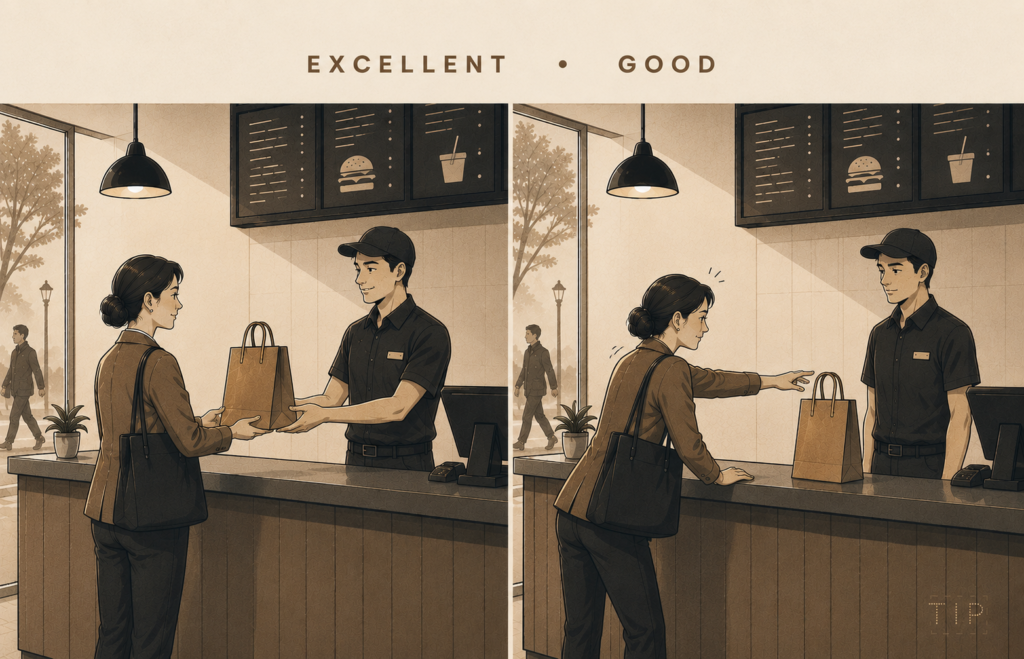
The difference between “excellent” and “good” is rarely a dramatic mistake. It’s usually a small behaviour left unfinished. Those moments don’t appear in complaints or dashboards, but over time they shape guest memory, loyalty and the commercial performance that follows. That’s where TIP begins looking.
The order was small. Deliberately small.
A Christmas-in-July promotion, a quiet afternoon, no queue behind me. I typed my son’s portion in first, watched it register on the screen, and then, out of pure curiosity, I stopped.
I didn’t call in the rest of the order.
I wanted to see what would happen when I asked for something the system hadn’t already written down.
I’m back in the present now. What follows is what I actually saw, and what it took me weeks to understand.
I asked for help finding the rest of my order. The girl at the counter, capable, polite, clearly new enough to still be finding her footing, looked toward a colleague standing a few feet away. He had the kind of stillness senior staff often carry, not doing much visibly, but everyone around him moving like he was the center of the room anyway.
She asked him. He checked. He hesitated, just slightly, the kind of pause that isn’t about not knowing the answer, but about needing to feel sure it was allowed before acting on it.
A minute later, I asked for a carry bag. Small thing. Two items, that’s all it needed to hold.
She checked with him again.
He slid the bag across without a word.
Nothing about that afternoon was rude. Nothing was incompetent. If you’d asked either of them how the interaction went, they’d probably have said fine, and they’d have been right, by the only measure they’d been given to judge it by.
What stayed with me wasn’t the pause. It was what the pause was made of.
Neither of them, at any point, felt able to act without checking first. Not for a fix. Not for a bag. The senior colleague wasn’t guarding some genuine risk, he was performing the only kind of certainty his role seemed to allow him, the certainty of someone waiting to be told he’d done the right thing, same as her.
That’s not a confidence problem in two individuals. That’s a signal about the system built around them. Somewhere, a system had taught two capable people that the safest action was always the smallest one, and that even small, safe actions still needed a witness.
I thought about the order I’d deliberately withheld. It hadn’t been urgent. It hadn’t been valuable. If anything, it was the lowest-stakes request a guest could make. And it still needed sign-off.
I’ve come to think this had nothing to do with confidence, and less to do with laziness than it might look. It had to do with what the promotion itself quietly communicated inside the building, before either of them ever met me. A discounted guest, in ways nobody would say aloud, gets treated as a slightly different category of guest, one whose requests carry a little more risk, a little more scrutiny, a little more need for permission. Not because anyone decided that consciously. Because somewhere in how the promotion was rolled out, staff absorbed the idea that this guest mattered a little less, or needed a little more watching.
I don’t think either of them would recognize themselves in that description. That’s exactly the point. It’s not what people believe about themselves. It’s what a system trains into behaviour long before belief ever gets consulted.
A few months later, somewhere else entirely, I watched something almost the opposite happen, and it taught me the same lesson from a different angle.
A quick-service counter in a shopping mall. I’d ordered snacks, waiting to collect. Nearby, a grilled sandwich came up for a different table, two families who’d ordered earlier and were sitting across the food court, out of easy earshot of the counter.
The team member who’d made it didn’t call the name and wait. She walked out from behind the counter, crossed the open floor, went to find them, and told them their order was ready.
That’s not a small gesture. That’s someone choosing, entirely on her own, to close a gap the system hadn’t asked her to close. No hesitation. No glance toward anyone senior. She simply decided the guest shouldn’t have to guess.
And then she walked back to the counter. The sandwich stayed on the tray. They collected it themselves.
I sat with that one for a while too, because it’s the inverse of the KFC moment in almost every way, and yet it rhymes with it perfectly.
At the first counter, nobody felt authorised to finish a small task without checking. At the second, someone acted with real independence, no checking required, and the task still stopped one step short of complete.
Different failure. Same root.
Neither person lacked competence. Neither lacked good intent. What both lacked was a system that had clearly defined what “done” actually looks like, for a promo guest, for a waiting family, for anything that fell slightly outside the standard script. One system left its people too afraid to finish small things. The other left its people unsure that finishing meant anything more than the gesture itself.
Systems that don’t define completion don’t just create gaps. They create people who genuinely believe they’ve done their job, standing right next to a guest who’s quietly decided the job wasn’t quite done.
None of this shows up anywhere a business actually looks.
It doesn’t appear in a complaint. Nobody at either counter would have filed a review, requested a refund, or told a manager anything went wrong, because from where they stood, nothing had. It shows up, if it shows up at all, as a guest who doesn’t come back quite as often, who recommends the place a little less enthusiastically than they otherwise would have, who remembers the meal as merely good instead of the excellent it could have been.
The gap between excellent and good is nearly invisible in any report a business runs. It has no line item. It doesn’t trip a threshold. It just quietly, cumulatively, decides how a brand is remembered by the people who’ve already walked out the door.
Here’s the part that I think matters most for how a business owner reads this. Not every business can afford that gap equally.
A brand with decades of trust behind it can absorb a thousand of these moments and barely notice. Momentum forgives a lot. Reputation, once built at scale, has room to be merely good without collapsing, the way a grown adult’s immune system can absorb an exposure that would seriously threaten someone with no built-up resistance at all.
A newer brand, still establishing itself, still earning its first loyal regulars, doesn’t have that room yet. The same behaviour, the same small incomplete gesture, the same hesitant handoff, costs it more, precisely because it hasn’t built the reserves to absorb the cost invisibly. It’s the same exposure. A wildly different consequence, depending on how much resistance has already been built.
That asymmetry is, I think, the real reason this kind of gap survives so long inside so many businesses. The biggest brands can carry it for years before it ever shows up somewhere a leadership team is required to look. By the time it does, it rarely reads as a behavioural pattern. It reads as “the market.”
It was never only the market.
Some of what a guest experiences was decided long before the bill arrived, in a moment no dashboard was ever built to catch, at a counter, over a bag, over a sandwich left one table short of where it needed to be.