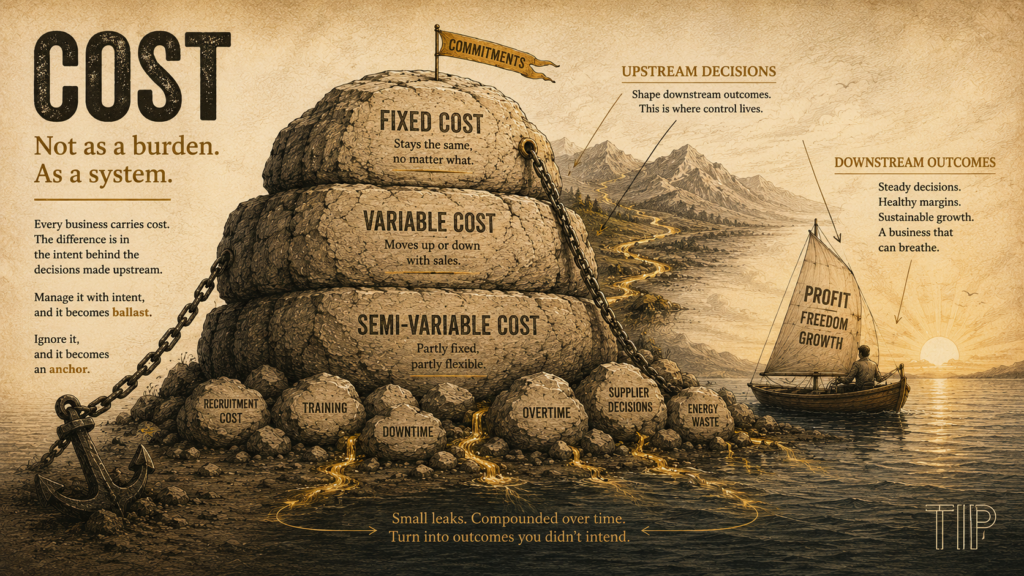
The Cost Landscape: Cost isn’t a destination. It’s a system. Every operational decision flows downstream into profit.
Why Behaviour, Not Budgeting, Determines Profitability
Picture two panels.
In the first, a man is roped to a boulder. Carved into the stone, one word: COST. He’s straining against it, and the boulder isn’t moving.
In the second, the same man is on a boat. Sky is bright. Money is scattered loose across the deck, not counted, not clutched — just there, the way it is when a business is finally breathing. He isn’t rowing. He’s looking up.
Same operator. Same industry. Same numbers, probably, if you audited both scenes on paper. The only thing that’s different is what the cost is doing to him — whether he’s tied to it or sailing past it.
That’s the whole article, really. Everything below is just unpacking why two operators can carry an identical cost base and live in completely different pictures.
This article is the foundation of TIP’s Cost Series. Three companion pieces — Staff Turnover, Supplier Reciprocity, and The Missing 1% — each explore one part of the landscape mapped out here.
The one line that needs no MBA
You don’t need a finance degree to know this:
Profit = Sales − Cost
That’s it. No trick to it. Every hospitality P&L in the country reduces to that sentence eventually.
But here’s the asymmetry almost nobody says out loud: Sales is negotiated with the world. Cost is negotiated with yourself.
Your topline is at the mercy of things you influence but don’t control — footfall, competitor openings, a suburb’s mood, a wet Saturday, a guest’s evolving idea of what a “good” venue even looks like this year. You can nudge sales. You cannot command it.
Cost is different. Cost sits inside the building. It’s the one lever that is fully in operational control, even when it doesn’t feel that way at 11pm with a kitchen still running and covers half of what you rostered for.
Which is exactly why cost is where the pressure has landed hardest across Australian hospitality right now — wages up, food inflation biting, energy and insurance climbing, rent unmoved by any of it. Not because cost is the only problem. Because it’s the only part of the equation an operator can actually grab hold of. So everyone grabs.
The boulder is real. So is the misreading of it.
Here’s where it gets interesting, and where most cost conversations stop too early.
Cost isn’t one thing. Broadly, it splits into two:
Fixed cost — rent, lease commitments, the capex-adjacent obligations that don’t move with how busy Tuesday is. Variable cost — the stuff that should breathe with volume: food cost, casual labour, consumables.
But there’s a third category most P&L templates don’t have a line for, and it’s the one that actually decides whether an operator sleeps at night: semi-variable cost.
Take labour. On paper, it’s variable — you roster to forecast, you flex the floor. But the moment that roster is published and the team turns up for the shift, it stops behaving like a variable cost. It’s locked. A slow Tuesday doesn’t send anyone home two hours early without a conversation, a morale cost, and usually a resignation six weeks later. The cost was decided days ago. What happens on the night just reveals it.
This is the boulder. Not cost itself — the lag between when a cost is committed and when its consequence shows up. Most operators are reacting to the boulder in real time, when the roped-in moment actually happened days earlier, at the point of commitment.
Attrition cost and retention value: where the boulder gets a number
Everything above describes cost as it’s felt. This part is different — this is cost as it’s counted.
Hospitality doesn’t just carry cost pressure differently to other sectors. It carries turnover differently. Recent Australian SME benchmarking places retail and hospitality at the top of organisations running turnover above 20% — 40%, against 39% for production and 38% for construction — and ABS job mobility figures confirm accommodation and food services among the highest-turnover sectors for employees changing jobs. This isn’t a bad-luck outlier. It’s the baseline the industry operates from.
Here’s where the boulder stops being a metaphor and starts being a line item. Estimates vary by source, but they cluster in the same band: industry benchmarking puts the cost of replacing a departing employee at a minimum of 50% of their annual salary, climbing to 150–200% for specialist or supervisory roles once recruiting, onboarding, lost productivity during ramp-up, and overtime paid to cover the gap are counted. Deloitte’s separate estimate lands close by, at roughly 1.5 to 2 times annual salary for a full replacement cycle. Run that against a modest venue losing a handful of team members a quarter, and the number stops looking like an HR footnote and starts looking like a second rent bill — one that never appears on the lease.
That’s the reframe this section exists to make. Attrition cost is tangible. It can be quantified, forecast, and budgeted against — which means it belongs to the same category of decision as rent or insurance, not the category of “just how hospitality is.” Retention spend, by contrast, is the rare cost in this entire discussion that is genuinely designed rather than absorbed: training time, scheduling stability, a visible path from floor to shift lead. It’s a known, chosen number — which makes it ballast, not boulder — and the receipt for what happens when the roster-lock mechanism above runs unmanaged for too long.
Attrition is the boulder that shows up on a payslip. There’s another version of it that never makes it onto any document at all.
Where the boulder hides in a delivery dock
There’s a version of cost that never shows up as a line item labelled “cost.” It shows up as a supplier relationship that’s been treated like a transaction for so long that nobody remembers it could be anything else.
Years back, running a large-format restaurant, we made a habit of getting our regular suppliers together, not for a negotiation, just to sit across a table as people. Over time, something shifted. Prices started arriving a little below market before we’d even asked for them. Then came a shrimp shortage that hit the whole market at once, other venues nearby ran dry. Ours didn’t. The suppliers we’d built that relationship with went out of their way to make sure we were covered, while competitors down the road were pulling shrimp off their menus. That one call didn’t just protect a dish that week. It protected covers, and it protected margin, at the exact moment neither was guaranteed.
Most operators price a supplier relationship the way they’d price a one-off invoice. Lowest number wins, this week. But a kitchen doesn’t run on this week. It runs on whether the fish arrives fresh on the one Friday the truck is running late for everyone else, whether a price hike gets flagged before it lands on your invoice instead of after.
That’s reciprocity, and it’s a genuine behavioural mechanism, not just a nice way to run a business. People, including suppliers, remember who treated them as a relationship and who treated them as a margin to be squeezed. The return on that memory shows up quietly — in the moments nobody’s watching, on the deliveries that aren’t in dispute, in the calls that get answered on a Sunday.
The boulder here isn’t the invoice total. It’s the cost of a relationship you’ve never actually built, showing up as a shortage on the one night you can least afford one.
Both of these — the departing employee and the underpriced relationship — share the same fingerprint. They’re costs that were decided long before anyone felt them. Here’s the part worth sitting with, because it explains almost every panicked cost decision you’ve watched a GM make.
Why the boulder feels heavier than the boat feels light
Behavioural economics has a name for what’s happening in that first panel: loss aversion. Kahneman and Tversky’s original finding, and the decades of research that followed it, put the ratio at roughly two to one — a dollar lost is felt something like twice as heavily as a dollar gained is enjoyed. The exact multiple shifts study to study. The direction never does.
Watch what that produces on the floor. A $2,000 cost blowout in a week gets an emergency roster review and a supplier renegotiation. A $2,000 sales upside gets a nod at the Monday meeting and no process changes at all. Same number. Opposite gravity.
This is why cost-cutting under pressure so often overshoots — why the instinct is to slash rather than to design. Loss aversion doesn’t ask “what’s the smartest lever here.” It asks “make the pain stop.” And the fastest way to make cost-pain stop is usually the worst way to run a venue long-term: cut a shift that was actually protecting service, drop a supplier relationship that took two years to build trust with, freeze a hire that was meant to fix the attrition line.
That last one is the trap worth naming. A frozen hire feels like savings today. But it’s borrowing against the 50–200%-of-salary replacement cost that shows up three months later when the understaffed shift pushes someone else out the door too. Loss aversion makes the visible saving feel real and the deferred attrition cost feel hypothetical — even though the second number is the one with a receipt attached.
The boulder doesn’t just weigh you down. It makes you swing the axe at the wrong rope.
The sailing panel isn’t about having less cost
This is the mistake worth naming directly: the second panel isn’t a man with no cost. He’s on a boat — boats have running costs too, fuel and maintenance and crew. The difference isn’t the absence of cost. It’s that this cost was designed with intent, ahead of the pressure moment, rather than reacted to inside it.
Intent, not less cost, is what turns the boulder into ballast — weight that stabilises the vessel instead of anchoring it to the seabed.
Practically, that means treating the semi-variable middle layer — labour, mostly, but also portion control, energy usage, waste — as the place where intent gets built in advance, not negotiated under fire. Roster against demonstrated demand patterns, not hope. Build supplier terms before the renewal deadline is a crisis. Decide the venue’s cost philosophy on a calm Tuesday, so that on the chaotic Saturday there’s nothing left to decide — only to execute.
The operators sailing aren’t the ones with better numbers. They’re the ones who moved their cost decisions upstream, out of the moment where loss aversion gets to vote.
But upstream doesn’t only mean the big decisions. Some of the heaviest weight on that boat is made of costs too small to have ever earned a decision at all.
The cost too small to notice, until it isn’t
Not every cost announces itself. Rent does. Wages do. A supplier price hike does. But there’s a category of cost that never sends a warning, because on any single day it barely registers.
A bit of stock rotated late. A reshuffle that eats ten minutes nobody bills for. A team member who could cover two sections but was only ever trained for one, so a Tuesday needs a body it didn’t have to need. None of these show up on a P&L as their own line. They hide inside other numbers, or they hide nowhere at all — just absorbed, shift after shift, as the cost of doing business.
Behavioural economists call this the Peanuts Effect. We discount small, recurring losses because each one feels too trivial to deserve attention. Hospitality creates dozens of those moments every shift. A little more waste here. A delayed delivery there. A few minutes of unnecessary movement across the kitchen. None of them look expensive. Together, they’re exactly where profitability quietly leaks away. That’s why I spent fifteen minutes most days doing one simple sweep, not because any single item mattered, but because I knew the accumulation would.
An eye on wastage and what was actually causing it, not just the volume. Guest complaints, and whether they traced back to service or to the plate itself. QQT on incoming supply, quality, quantity, and whether it landed on time, because a late or short delivery has a way of becoming three other problems by dinner service. All of it sat on a single one-page checklist, built around the ten or so cost items that moved the needle most, so nothing on it needed rediscovering every day. It was never dramatic to run through. That was rather the point.
This is the boulder at its most deceptive. Not heavy enough to feel, until a year of not feeling it adds up to a number that would have gotten a room’s attention if it had arrived all at once.
That’s the last shape the boulder takes in this article. Not a single heavy thing, but hundreds of light ones nobody stopped to weigh.
Where this leaves the industry — and where it leaves you
Cost isn’t the villain. It’s not even really the boulder. The boulder is what cost becomes when it’s only ever confronted in its most painful, most reactive, most emotionally loaded moment.
Behaviour is the only brief that never lies — and cost, more than almost anything else in a hospitality P&L, is where behaviour shows its hand. Not the guest’s behaviour. The operator’s. So the real question this article is circling isn’t “how do we cut cost.” It’s: at what point in the week does your business actually decide its cost — and is that point calm, or is it already underwater?
Cost is where a business proves it can survive its own pressure. What comes after cost is a different question entirely — not whether the numbers hold, but who on the floor is the reason they do.