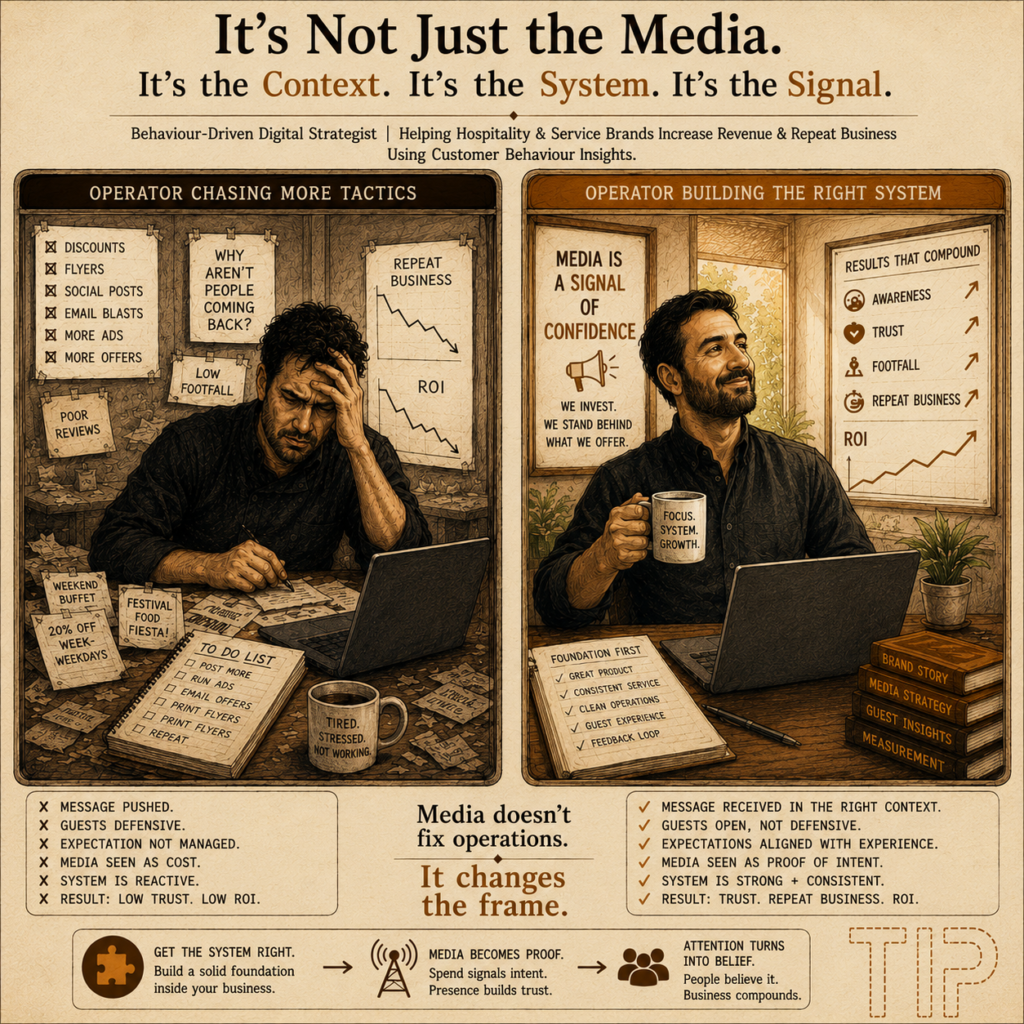
We always talk about media like it’s the only thing that builds belief. But it isn’t, not really. It’s the context the message shows up in.
I saw this play out years ago at Barbeque Nation. We ran quarterly food festivals, and we advertised them the old way, through fliers tucked into the newspaper. A guest had come in once, before one of these festivals, and had a mediocre visit. Service was slow that night. Nothing dramatic, just forgettable. They never came back.
If you’d asked them to try us again, they’d have said no without thinking twice. Their mind had already filed us under “not worth it,” and it was actively defending that file.
Then one Sunday morning, flipping through the paper for something else entirely, they landed on a flier for our next festival. Not pitched at them directly. Not a sales call, not a follow-up email, not someone trying to win them back. Just there, tucked between the news and the rest of the paper.
A few weeks later, they walked back in.
The Guard Comes Down When the Mind Is Elsewhere
Nothing about the food or the service had changed between that first disappointing visit and the festival. What changed was the guest’s state of mind when the message arrived.
They weren’t evaluating us. They weren’t relitigating that one bad night. They were reading the paper for something else entirely, and the flier slipped in underneath all of it.
This is the part of how guests actually respond that doesn’t get talked about enough on the floor: people are far less defensive when their mind is already occupied elsewhere. A message has a better shot at landing softly in that gap than it ever would in a direct, high-friction conversation where someone is actively deciding whether to give you a second chance.
This isn’t unique to restaurants. The same mental wiring shows up in retail, SaaS, enterprise sales, luxury goods. Only the backdrop changes. Whether it’s a flier in a newspaper, an ad in a podcast someone has playing in the background, or a post someone scrolls past on a tired evening, the mechanism is the same. The mind that isn’t actively guarding itself is the mind most open to reconsidering.
Why Spending on Media Is Itself a Signal
There’s a second piece here that gets misread, especially by operators trying to keep costs lean.
Advertisements cost money, sometimes a lot of it. But that cost is part of why they work. People don’t just respond to the ad itself. They respond to the fact that a brand was willing to spend money to be seen. That willingness to invest is a signal that words alone can’t fake.
Brands that understand this stop treating media as a line item to minimize. They start treating it as proof of confidence, a signal that says: we stand behind what we offer strongly enough to put money behind being visible.
That’s a different psychological object than an ad. An ad tries to persuade. Spend, visible and sustained, quietly demonstrates conviction. Guests read that conviction whether or not they could ever articulate it.
The Same Lever That Helps One Brand Can Wreck Another
Here’s where most operators get burned, and it’s the part that rarely makes it into marketing conversations.
A psychological tendency that helps one brand can quietly hurt another. The same lever that shifts perception favorably for one brand can wreck it for a different one, depending on what’s actually happening behind the message.
A message that softens resistance in one setting hardens it in another. High expectations can elevate a product, or they can destroy it the moment reality doesn’t match what was promised. A small, visible flaw can even build trust, but only in a place where competence was already obvious before the flaw showed up. If the fundamentals aren’t there yet, the same flaw just confirms the doubt a guest already had.
No single lever holds up a brand on its own. Not the product. Not the service. Not the digital interface. And certainly not one good press mention or one well-placed flier.
Media Doesn’t Fix a Flawed Operation. It Changes the Frame.
This is the line I keep coming back to from years on the floor, not from a marketing textbook: media does not fix a flawed operation. What it does is change the frame in which the operation gets judged.
If the internal system is weak, media cannot rescue the brand. A guest who tries you because of a well-placed ad and then has the same disappointing experience the last guest had will simply update their internal file faster and more permanently. Media accelerates whatever is already true.
If the internal system is strong, media doesn’t need to rescue anything. It simply amplifies the confidence, consistency, and clarity that already exist on the floor, in the kitchen, and in every guest interaction that happens when no one from marketing is watching.
That’s why doing it right the first time matters more than any campaign. When the system is built correctly from the start, media stops being noise. It becomes proof.
Where This Leaves Operators
Most agencies sell media. That’s their product, and there’s nothing wrong with that. But I look at what happens in the guest’s mind before the media even reaches them, what they’re already carrying, what they’re defending, what state they’re in when your message shows up.
Spend signals intent. Presence builds trust. Eventually, people believe it, not because the media was clever, but because the investment itself became part of the story they were already telling themselves about whether you were worth reconsidering.
And that shift, from being overlooked to being fairly reconsidered, is usually smaller than operators think. It rarely requires a bigger budget or a louder campaign. It requires the right frame, built on a system that was already solid before the message ever went out.
That’s the whole discipline, in one line: get the operation right first. Then let media do what it was always meant to do, not persuade, but prove.
A guest who once wrote you off can still walk back through the door, not because anything changed, but because of the state of mind they were in when your message reached them. On context, confidence, and why media proves a business rather than fixing one.